
Note: I wrote this post in December 2025, for the holiday season. But the principles in it apply all year round -- any time you or anyone around you needs emotional or nervous system support.
Social gatherings and even just family meal times are supposed to be enjoyable. But the hope or expectation for connection and good feelings often creates pressure on us to "perform."
We want to be fun and light-hearted and patient and present for our kids and each other, but we may also be stressed out, exhausted, and hustling, and the to-do list never gets any shorter.
For many of us this spells an invitation to the inner critic, who starts relentlessly cracking the whip to make sure we're up to snuff.
And along with all that pressure, for some of us the holiday season also awakens an aching emptiness inside which can never be filled with tinsel and material gifts. Because while we're trying to meet other people's needs, there's also a little child inside each of us that needs our presence and attention.
This is what our own parents may not have been able to give to us when we were small. And if presence and connection is lacking internally, then the harder we try to be provide this for the people around us the more impoverished we feel internally -- leading to bitterness and resentment.
Strings of fairy lights
Picture a big Christmas tree with lots of strings of fairy lights threaded all over and through its branches.
Each string of lights makes its own pattern on the tree.
But not all the strings of lights are working the same. Some keep blinking on frantically and constantly; others are inhibited -- they're dim, or they don't light up at all.
These strings of lights winking on and off represent the neural activity in your brain. (See the Extras section down the bottom for more clarity on this, if you want to.)
It could be said that each string of fairy lights represents a "part" of you.
You know how sometimes we say things like, “There’s a part of me that enjoys the holiday season and a part of me that doesn't" --well, "parts"are a thing.
Each part of you is like a child in a family -- your own inner family of parts. (Hence the name for the mental health modality that I'm describing - it's called "Internal Family Systems".)
When needy ones make trouble
In our internal family systems, there are parts that did not get their needs met when we were little. And just like in the "real" families that gather around tables during the holiday season and other social occasions, sometimes the parts whose needs have not been met will make trouble.
Because even though there are no "bad" parts, none of our parts have the full picture. And many of them are functioning at the level of a small, distressed child.
That's why on our imaginary Christmas tree, some strings of fairy lights shine frantically and some are dim or don't shine at all -- the needy, distressed parts are taking up all the brain space, effectively shutting the rest of the system down or causing it to malfunction.
Playing with the fairy lights
Now, imagine that a calm, curious, compassionate, confident, courageous, creative being is playing with the strings of fairy lights.
Tuning into them to understand what they need. Soothing and attending to the loud, controlling ones so that they can relax and make space for other parts; helping the shy, inhibited, doubtful ones shine brighter. So now there are more lights turned on, and they're all shining more harmoniously.
In other words, you are more emotionally regulated and your brain is functioning at something closer to its true capacity.
Who is this calm, compassionate being?
It's you, when you are in a state of emotional regulation - a state of clarity and connection. In Internal Family Systems this is called the "Self." Ideally, your Self is a bit like a parent to all the parts.
A lot of intensity
As I write, Christmas is a few weeks away. Families are trying to come together, or dealing with the feelings that arise when they can't, or when coming together hurts.
What if the single most useful, productive thing you could do to ease things is to take care of your internal family, so you can be more regulated and resourced for whatever is going on in your outer world?
Paradoxically, this care and attention for yourself is far more important than any task on your to-do list. Less urgent, probably, but more important. So, here are three suggestions that might help.
1. Take three conscious breaths
Begin with three breaths. Without trying to change your breathing at all, just follow it. Be open, receptive, curious, about what you might find inside there where your breath goes.
My 14 year old son calls this "breathing on manual," and he says that as soon as you pay attention to your breath, it feels awkward and you "forget how to breath."
If that feels like what happens for you when you focus on your breath, just stay with it. You can handle it for three breaths.
The awkwardness is the sensation of your brain having to get out of autopilot and light up strings of fairy lights that are normally dark.
More fairy lights means more capacity.
Try making a habit of taking three conscious breaths each time you transition from one place or task to another.
With a bit of practice, this simple act of focusing on your breath and following it inward might lead to your breath slowing down and deepening.
A little bit spaciousness might open up inside you.
Some of your tension may diminish, a little or a lot.
You might even feel a sigh of relief from your constricted parts.
(I wrote more about this in "Breathe Yourself Home.")
2. Try this 5-breath meditation from Thich Nhat Hanh
Here's a short breath meditation from the book Silence by Buddhist Monk and peace activist, Thich Nhat Hanh.
This requires that you pay attention for 5 full breaths. You can do it. Repeat after me:
"Breathing in, I know I'm breathing in ...
Breathing out, I know I'm breathing out
Breathing in, my breath grows deep ...
Breathing out, my breath grows slow
Breathing in, I feel my body ...
Breathing out, I calm my body
Breathing in, I smile ...
Breathing out, I release
Breathing in, I'm in the present moment ...
Breathing out, I enjoy the present moment."
For me, when I try to smile on the fourth in-breath, I'm sure it looks more like a grimace. It's awkward. More under-used strings of fairy lights are being coaxed into lighting up. But smile or no smile, I'm happy to report that every time i remember to use this practice, I feel better.
I also use it with changes to the wording, according to my need:
"Breathing in, I acknowledge my anxiety ...
Breathing out, I release my anxiety.
Breathing in, I acknowledge my fear ...
Breathing out, i release my fear.
Breathing in love ...
Breathing out gratitude."
Don't be fooled by the apparent simplicity. Remember, you're not trying to impress another adult; you're trying to sooth your inner 4 year old.
3. As well as your breath, use your finger tips
EFT stands for Emotional Freedom Technique. It's also often just called "Tapping," because it involves tapping with your finger tips on acupressure points on your face and upper body to send calming signals that let the alarm centers in your brain know it's safe to relax. Meaning, more lights can come on.
Even if you don't know anything about EFT, it's very simple to use in combination with your breath for "inner first aide."
(Later, I'd encourage you to learn more about EFT -- see the Extras down the bottom -- but this is a way to get some of its benefits right now, without needing to know anything about it beyond what I've just told you.)
Here are the steps:
- If you've never tapped before, tap 7 to 10 times gently with your finger tips on each of the points, following the chart below, to get a feel for it. Start with the "side of the hand" point, then follow the others as they're numbered. (Skip the "gamut" point for now, you don't need it for this exercise.)
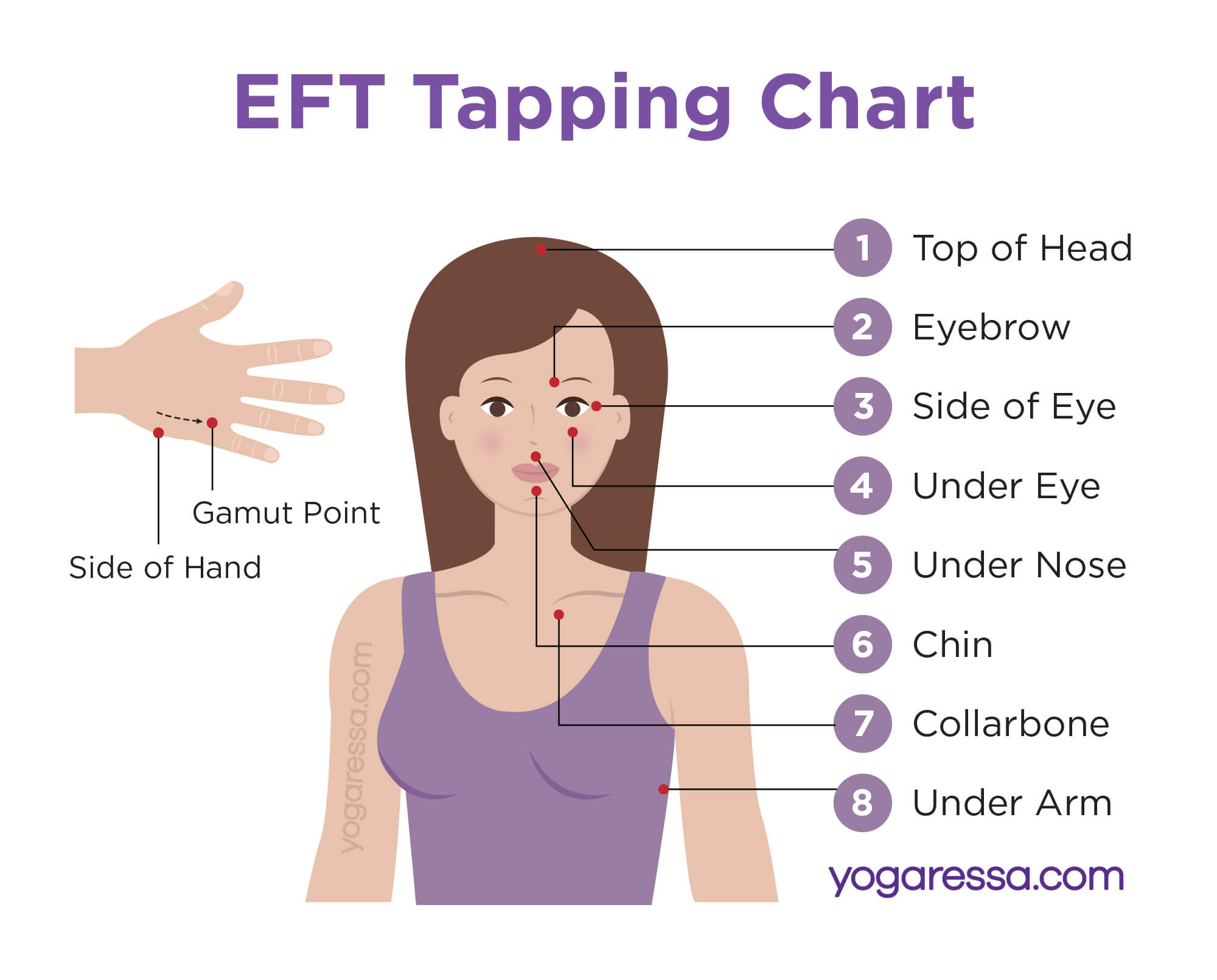
- Once you're familiar with tapping on the points, pause, take a breath, then start again from the beginning.
- Tap 7 to 10 times on the "side of the hand" point while you breathe in. Tap 7 to 10 times on the "top of the head" point while you breathe out.
- Continue to follow the chart for the rest of the points -- breathe in as you tap on one point; breathe out as you tap on the next one. It doesn't matter which points you breathe in for and which you breathe out for. It doesn't matter if you miss a point or do them in the wrong order. You cant get this wrong.
- Ask your inner critic part to give it at least one full round of tapping without worrying about how you're doing.
- Then, once you start to get the hang of it, slow. Way. Down. Slow your tapping. Invite your breath to slow. Lengthen your out-breath to be a bit longer than your in-breath. Your breathing my grow deeper all by itself -- what a relief 🙂
- Tap lightly, softly, with love and compassion and care and attention. Be as gentle with yourself as you would with a little child.
Well done you
You've just generated a few moments of peacefulness in your internal world.
Take a moment to cherish yourself and congratulate yourself.
In the culture and times that most of us are finding ourselves in right now, this is the most counter-intuitive work there is -- and by far the most needed.
May your in-breath be deep, your out-breath be long, and all your strings of fairy lights shine in harmony at least occasionally during times of stress, including but not limited to the holiday season 🙂

Extras
On strings of fairy lights to represent neural activity in your brain:
The main signaling cells of the brain are the neurons (the "fairy lights"), each with connections to other neurons that create neural "pathways" (the "wiring").
When a neural pathway has been reinforced by strong emotions and/or by lots of repetition, the connections between those neurons get stronger and this pathway becomes more like a "super highway" - easy to follow and hard to find an exit from.
In my amateur understanding and in my personal experience, each distressed "part" -- for example, the critical part, the anxious part, the appeasing part, the overwhelmed part -- has its own well-worn neural pathways. Healing all this distress involves teaching the parts of myself that they can make new pathways, behave in new ways, and in doing so, light up new parts of my entire nervous system (not just my brain) that have long been shut down.
I learned to think about all of this in this way partly from this excellent set of videos (5 videos, each 12 to 20 minutes long).
On EFT (Emotional Freedom Technique):
Scroll down to the diagram in this article for a good guide on the acupressure points used in basic EFT, including the specific Chinese acupuncture meridian involved and specific ways each one of them can help you feel better.
Here's a good starting point if you'd like to learn more about EFT online. This organisation also has an Ap you can download to your phone. I have not tried the Ap, but I frequently reference the huge archive of articles on their website.
There are also some really great books about EFT. I can personally recommend the book Tapping by David Feinstein, Ph.D. and Donna Eden if you're in for a comprehensive deep dive, and there are many, many others.
Please comment...
Thoughts? Please scroll down and share them..